Email Address
info@anantengineering.com
Phone Number
+91-70214-18176
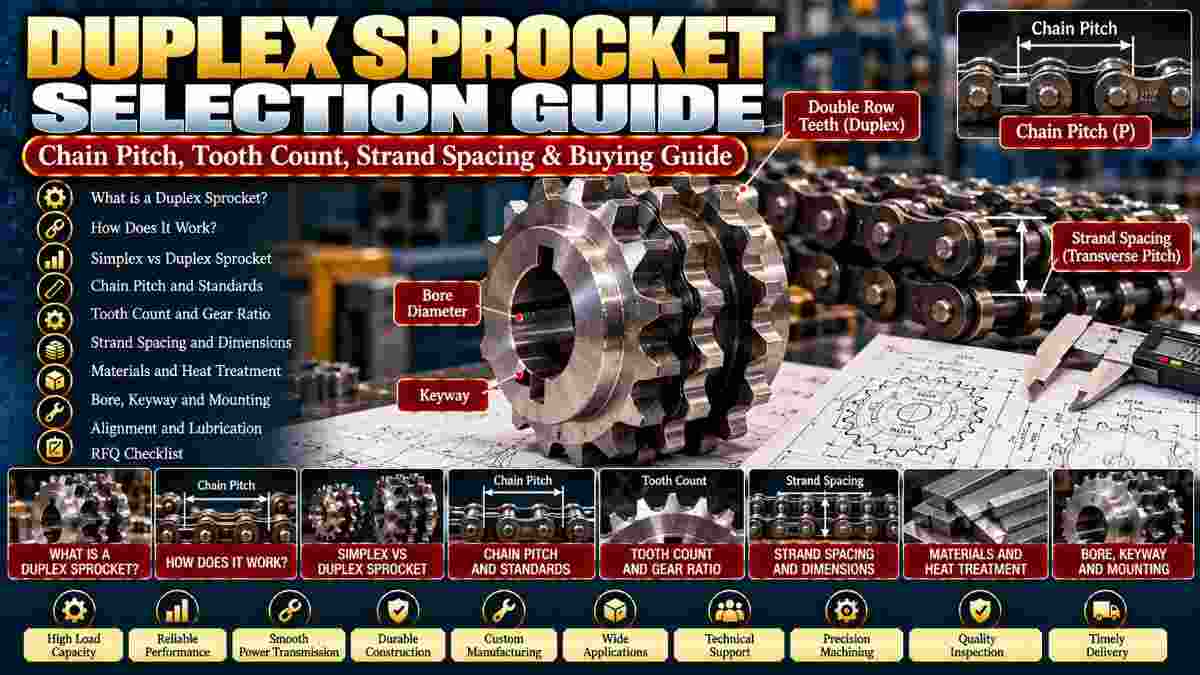
Are you replacing a worn sprocket or designing a heavy-duty chain transmission system? Incorrect sprocket dimensions, chain pitch, or shaft connections can cause uneven wear, vibration, and unexpected machinery downtime.
Duplex sprocket selection depends on chain designation, pitch, tooth count, strand spacing, shaft diameter, transmitted torque, operating speed, and mounting requirements.
Anant Engineering offers industrial duplex sprockets for conveyors, manufacturing equipment, and power transmission systems.
A duplex sprocket is a toothed wheel with two parallel rows of teeth designed to engage a compatible double-strand roller chain.
Its applications include:
Industrial conveyors.
Material-handling equipment.
Cement machinery.
Agricultural equipment.
Packaging machines.
Heavy-duty transmission drives.
Explore Duplex Sprockets for available product options.
A duplex sprocket transfers rotational power through two parallel chain strands engaging the sprocket's matching tooth rows.
The arrangement allows both strands to participate in transmitting the load.
Proper alignment and compatible chain dimensions are essential for reliable engagement.
A simplex sprocket has one tooth row, while a duplex sprocket has two rows for a double-strand chain.
Duplex drives may provide greater power transmission capacity than comparable single-strand arrangements when correctly engineered.
However, load capacity depends on the chain size, sprocket design, speed, lubrication, and service conditions.
A duplex sprocket cannot directly replace a simplex sprocket without evaluating the entire drive.
Chain pitch is the center-to-center distance between adjacent roller chain pins and must match the sprocket tooth geometry.
Before ordering, verify:
Chain standard.
Chain designation.
Nominal pitch.
Roller diameter.
Inner link width.
An incorrect pitch can prevent proper engagement and accelerate wear.
Strand spacing is the transverse distance between the two chain rows and must correspond to the sprocket's tooth-row spacing.
Chains with identical longitudinal pitch may have different transverse dimensions.
For example, ANSI and British Standard chain families are not automatically interchangeable.
Specify the complete chain designation instead of requesting only a particular pitch.
Tooth count affects the drive ratio, sprocket diameter, chain articulation, and operating characteristics.
For a conventional chain drive:
Speed Ratio = Driven Sprocket Teeth ÷ Driving Sprocket Teeth
For example, a 20-tooth driving sprocket and a 40-tooth driven sprocket provide a theoretical 2:1 speed reduction.
Final tooth counts should follow chain manufacturer recommendations and the drive's loading requirements.
Critical dimensions include tooth count, pitch diameter, overall width, row spacing, bore diameter, hub dimensions, and keyway geometry.
Check:
Chain designation.
Number of teeth.
Sprocket outside diameter.
Tooth-row spacing.
Tooth thickness.
Bore diameter.
Hub length.
Keyway dimensions.
For replacement orders, provide an approved drawing or original sample.
Bore and keyway dimensions establish how the sprocket fits the shaft and transmits torque.
Buyers should identify the shaft diameter, bore tolerance, keyway size, hub arrangement, and any locking features.
Incorrect dimensions may cause assembly problems or damage the shaft connection.
Material selection depends on transmitted load, operating environment, wear requirements, and expected duty cycle.
Common options include:
Carbon steel.
Alloy steel.
Hardened steel.
Application-specific corrosion-resistant materials.
Anant Engineering also lists induction-hardened and flame-hardened tooth options.
Material and heat-treatment requirements should be matched to the actual application.
Torque and rotational speed determine the load transmitted through the chain and influence suitable sprocket dimensions.
Consider:
Motor power.
Input RPM.
Normal operating torque.
Starting loads.
Shock loading.
Daily operating hours.
The chain and sprocket must be evaluated as a complete drive system.
Correct alignment and lubrication support smooth chain engagement and help reduce premature wear.
Inspect sprocket parallelism, shaft positioning, chain tension, and lubrication condition.
Misalignment may cause uneven loading across the two chain strands.
Follow the chain manufacturer's lubrication and maintenance recommendations.
Common causes include incorrect chain tension, misalignment, inadequate lubrication, abrasive contamination, and excessive loading.
Warning signs include:
Hooked or worn teeth.
Uneven tooth wear.
Chain elongation.
Abnormal vibration.
Excessive noise.
Damaged hub connections.
Inspect both the chain and sprocket before replacing components.
A replacement must match the chain standard, tooth geometry, strand spacing, mounting dimensions, and operating requirements.
Check the original component marking, chain designation, tooth count, bore, keyway, hub, and material specifications.
Avoid selecting a replacement based only on outside diameter.
Prices depend on chain size, tooth count, material, machining requirements, heat treatment, hub design, and quantity.
Custom bores, specialized coatings, and inspection requirements may also influence the quotation.
Compare suppliers using identical specifications.
A complete RFQ should identify the chain system, sprocket geometry, shaft connection, operating conditions, and quantity.
Provide:
Machine application.
Chain standard and designation.
Chain pitch.
Required tooth count.
Strand spacing.
Bore diameter.
Keyway and hub dimensions.
Material and heat treatment.
Motor power and RPM.
Normal and peak loading.
Technical drawings or samples.
Quantity and delivery location.
Complete specifications reduce the risk of incorrect replacements.
Anant Engineering offers duplex sprockets for industrial chain transmission applications, including custom manufacturing requirements.
Its product page describes carbon steel and alloy steel designs, tooth-hardening options, finished bores, keyways, and hub configurations.
Explore Duplex Sprockets for product information.
Confirm dimensions, load suitability, material specifications, and availability before ordering.
Common questions concern chain compatibility, load capacity, sprocket dimensions, and customization.
No. A conventional duplex sprocket is designed for a compatible double-strand chain.
They can support higher transmission loads than comparable simplex arrangements when the complete drive is correctly designed.
Not automatically. Chain dimensions, tooth geometry, and transverse spacing must be verified.
Yes. Custom tooth counts, bores, keyways, hub arrangements, and material specifications may be available.
Inspect both components. Replacing a severely worn component while retaining an incompatible or excessively worn mating component can shorten service life.
You can request a quotation by providing the chain designation, pitch, tooth count, bore, keyway, material requirements, quantity, and operating conditions.
For replacement orders, include the existing drawing or component sample.
Explore Duplex Sprockets or contact Anant Engineering to discuss your requirements.
Technical Note: Final sprocket selection must follow compatible roller chain standards, manufacturer load ratings, approved drawings, and drive design calculations.













Anant Engineering is a leading manufacturer of high-quality industrial gears, couplings, and power transmission components. We provide precision-engineered solutions designed for maximum durability and performance across heavy industries.Our products are built to handle the most demanding industrial environments, ensuring your machinery operates with absolute accuracy and reliability. Whether you require standard gear units or custom-engineered components, we deliver the performance-based solutions your business needs to stay ahead. Partner with us today and take your industrial quality and profits to the next level!