Email Address
info@anantengineering.com
Phone Number
+91-70214-18176
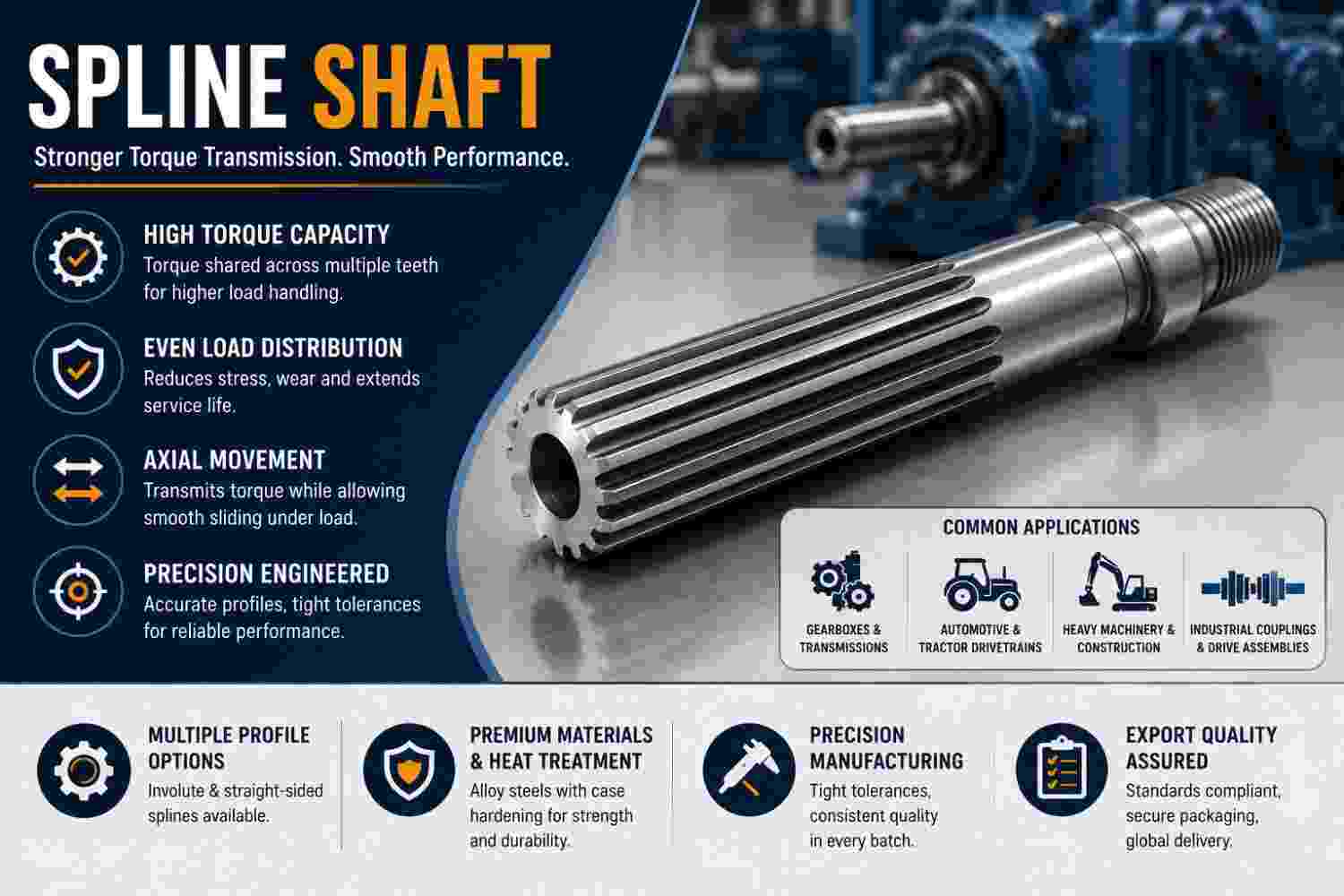
A spline shaft is a shaft with multiple longitudinal teeth cut along its length, designed to transmit torque while allowing controlled axial movement or precise alignment between mating components. Instead of relying on a single keyway to carry the load, the teeth are spread around the shaft's circumference, distributing torque more evenly across the interface.
A keyed shaft transfers torque through one small key and keyway, which concentrates stress in a single narrow zone. A spline shaft spreads that same torque across many teeth instead, reducing the load carried by any single point of contact. For a given shaft size, this generally allows a spline design to handle higher torque than an equivalent keyed shaft before fatigue becomes a concern.
When torque is shared across multiple teeth rather than concentrated at one point, each tooth carries less stress. Lower stress per tooth translates into better fatigue resistance and slower wear over repeated engagement cycles, which is particularly important in systems that start, stop, or reverse direction frequently.
Performance comes down to three factors: tooth profile accuracy, fit tolerance, and surface finish. These are typically determined after evaluating torque requirements, engagement length, operating speed, and how much axial movement the application needs — a shaft engineered for a fixed coupling has different requirements than one designed to slide under load.
Precision machining keeps the spline geometry uniform along the full length of the shaft, which matters because inconsistent geometry creates uneven contact and localized wear. Controlled heat treatment then improves wear resistance at the tooth surface without sacrificing the toughness of the shaft's core, allowing it to handle cyclic loading without becoming brittle.
Loose fit between a spline shaft and its mating hub creates backlash — a small amount of play that shows up as noise, vibration, and accelerated wear over time. Tight manufacturing tolerances keep this play to a minimum, ensuring the shaft and hub engage cleanly and transfer torque without excess movement between them.
The two most common profiles are involute splines and straight-sided splines. Involute splines have a curved tooth profile similar to gear teeth, which self-centers the mating components and handles higher loads more efficiently. Straight-sided splines are simpler to manufacture and are often used in lower-load or lower-precision applications where cost matters more than maximum load capacity.
Carbon steel is typically used for standard-duty applications, while alloy steels such as EN8, EN19, and EN24 handle higher-stress conditions. Case-hardening grades like EN353 and 20MnCr5 are chosen when the tooth surface needs added wear resistance without compromising the ductility of the core material underneath.
Yes — both processes are commonly available. Case hardening treats the surface layer to resist wear while keeping the interior tough, and induction hardening offers a faster, more localized way to harden specific areas of the shaft. The right choice generally depends on the load pattern and which sections of the shaft see the most contact stress.
Yes — their ability to share torque across multiple teeth makes them well suited to heavy-duty drivetrains, gearboxes, and industrial machinery where a single-key design would concentrate too much stress in one location. This is one of the main reasons they're chosen over keyed shafts in demanding torque transmission systems.
Typical applications include gearboxes and transmission systems, automotive and tractor drivetrains, heavy machinery and construction equipment, industrial couplings and drive assemblies, and any power transmission unit that requires axial movement alongside torque transfer.
Yes — this is one of the defining advantages of the design. Because the mating teeth remain engaged along the shaft's length, a spline shaft can transmit torque while still allowing the mating component to slide axially, which is essential in systems like tractor drivetrains where engagement length changes during operation.
Common options include the choice between involute or straight-sided splines, specific tooth counts, pressure angles, shaft diameters, and end configurations. This flexibility allows a shaft to be built for both new equipment and direct replacement applications without requiring modifications elsewhere in the assembly.
Yes — manufacturing from drawings or an existing physical sample is a standard option, which is particularly useful when replacing a worn shaft in older machinery where original specifications may no longer be available or documented.
Reliable production involves strict checks for dimensional accuracy, hardness, and surface finish on every batch, along with heat treatment for extended service life. Compliance with recognized spline standards and secure packaging for transport further reduce the risk of inconsistency between shipments, which matters for buyers sourcing at scale.
Before placing an order, confirm the required torque and speed, engagement length, and how much axial movement the application needs. It also helps to specify the spline profile, tooth count, pressure angle, and shaft diameter upfront, along with any shoulder or mounting features needed to fit your existing assembly.
A spline shaft earns its place in high-stress power transmission systems by solving a problem keyed shafts can't — spreading torque across multiple contact points instead of concentrating it in one. Getting the tooth profile, fit tolerance, and material selection right ensures that advantage actually translates into longer service life and reliable performance under cyclic or sliding loads.
Reach out to a technical team with your torque, engagement length, and material requirements for guidance on custom shaft manufacturing.













Anant Engineering is a leading manufacturer of high-quality industrial gears, couplings, and power transmission components. We provide precision-engineered solutions designed for maximum durability and performance across heavy industries.Our products are built to handle the most demanding industrial environments, ensuring your machinery operates with absolute accuracy and reliability. Whether you require standard gear units or custom-engineered components, we deliver the performance-based solutions your business needs to stay ahead. Partner with us today and take your industrial quality and profits to the next level!