Email Address
info@anantengineering.com
Phone Number
+91-70214-18176
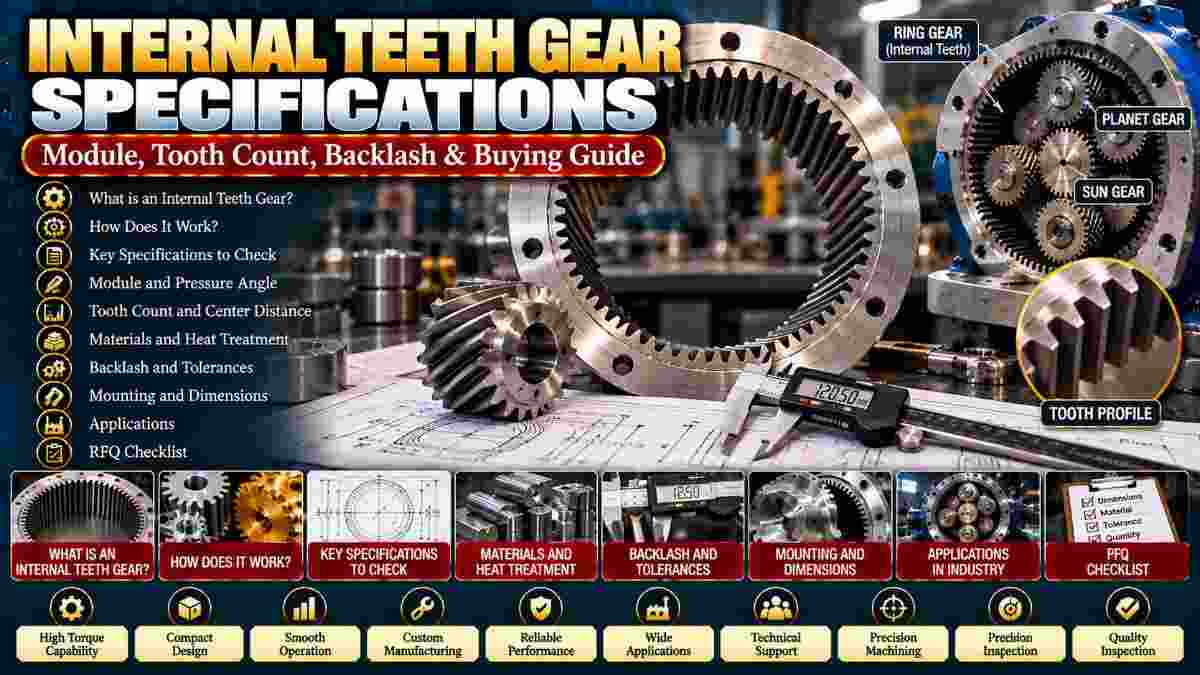
Are you sourcing an internal gear for a planetary gearbox, industrial reducer, or replacement transmission assembly? Incorrect tooth geometry or mounting dimensions can cause interference, noise, premature wear, and assembly problems.
Internal teeth gear specifications should include module, tooth count, pressure angle, pitch diameter, face width, material grade, backlash, mounting details, and mating pinion dimensions.
Anant Engineering offers industrial gear products for machinery and power transmission applications.
An internal teeth gear is a circular gear with teeth machined along its inner circumference, allowing it to mesh with an externally toothed pinion or planet gears.
It is also commonly called an internal ring gear.
Typical applications include:
Planetary gearboxes.
Industrial reduction drives.
Automotive transmission assemblies.
Robotics equipment.
Heavy machinery.
Compact power transmission systems.
Explore Internal Teeth Gears for product information.
An internal gear transmits rotational motion through teeth on its inner surface that engage a compatible external gear.
In a simple internal gear pair, both gears rotate in the same direction.
Planetary gearboxes use a different arrangement involving a sun gear, planet gears, and an internal ring gear.
Their operating ratio depends on which member drives, which remains fixed, and which provides the output.
Internal gears help create compact planetary transmissions by providing an outer toothed ring for the planet gears to engage.
Potential advantages include:
Compact gear arrangements.
Multiple gear contact paths.
Flexible transmission configurations.
High torque density in suitable designs.
Coaxial input and output arrangements.
Actual performance depends on the complete gearbox design.
Module defines the nominal tooth size in a metric gear system and must be compatible with the mating gear.
For a standard spur gear:
Module = Pitch Diameter ÷ Number of Teeth
When ordering, specify whether dimensions use metric module or diametral pitch.
For helical internal gears, distinguish normal module from transverse module.
Tooth count and pressure angle influence gear geometry, meshing, operating center distance, and interference risk.
Specify:
Internal gear tooth count.
Mating pinion tooth count.
Module.
Pressure angle.
Tooth profile.
Profile modification, if applicable.
Two gears with matching modules may still be incompatible if other tooth geometry differs.
For an unmodified, parallel-axis internal spur gear pair, center distance is based on the difference between the pitch diameters.
The standard relationship is:
Center Distance = Module × (Ring Teeth − Pinion Teeth) ÷ 2
For example, a module 2 internal gear with 60 teeth and a compatible 20-tooth pinion has a standard center distance of 40 mm.
Profile shifts or modified operating geometry can change the required center distance.
Internal gear dimensions determine tooth engagement, component clearance, housing fit, and mounting compatibility.
Important dimensions include:
Pitch diameter.
Inner tooth-tip diameter.
Tooth-root diameter.
Ring outside diameter.
Face width.
Mounting-hole positions.
Internal gear teeth point inward, so their diameter relationships differ from those of external gears.
Backlash is the clearance between mating gear teeth and is necessary for proper operation under specified conditions.
The appropriate backlash depends on:
Gear geometry.
Operating temperature.
Lubrication.
Manufacturing tolerances.
Shaft and bearing arrangements.
Application requirements.
Excessive backlash can cause positioning errors and noise, while insufficient backlash may contribute to binding.
Internal gear interference occurs when incompatible tooth geometry prevents gears from meshing or rotating correctly.
Engineers may evaluate:
Involute interference.
Trochoid interference.
Trimming interference.
Pinion tooth count.
Tooth profile modifications.
Internal gear designs require particular attention to interference because the teeth mesh within the ring.
Material selection depends on transmitted torque, operating speed, tooth loading, wear requirements, and the application environment.
Common choices include:
Carbon steel.
Alloy steel.
Case-hardened steel.
Through-hardened steel.
Other application-specific materials.
Heat treatment may be required for suitable surface hardness and fatigue resistance.
Confirm material specifications with the gear manufacturer.
Concentricity and mounting accuracy help maintain consistent tooth engagement and load distribution during rotation.
Inspect:
Gear bore or locating diameter.
Tooth concentricity.
Mounting face.
Bolt-hole positions.
Housing fit.
Axial alignment.
Incorrect mounting can produce uneven wear and vibration even when the gear teeth are manufactured correctly.
Internal gear inspection verifies tooth geometry, critical dimensions, material condition, and compatibility with approved drawings.
Depending on the project, checks may include:
Tooth profile.
Pitch accuracy.
Tooth thickness.
Runout.
Concentricity.
Surface finish.
Material hardness.
Gear mesh inspection.
Request the inspection documentation appropriate to the application.
Premature wear may result from overloading, insufficient lubrication, poor alignment, contamination, or unsuitable tooth geometry.
Warning signs include abnormal noise, vibration, pitting, scoring, excessive backlash, and localized tooth damage.
Inspect the mating gears, bearings, and housing before replacing the ring gear.
A replacement internal gear must match the existing assembly's tooth geometry, material specifications, mounting dimensions, and operating requirements.
Verify the original gear designation, mating pinion specifications, module, tooth count, pressure angle, backlash, and housing dimensions.
Provide approved drawings or a sample whenever possible.
Internal gear prices depend on gear size, material, tooth geometry, machining complexity, heat treatment, inspection, and order quantity.
Custom tooth profiles, restrictive tolerances, special mounting features, and additional finishing processes may affect the quotation.
Compare suppliers using identical specifications.
A complete RFQ should describe the gear geometry, mating components, operating loads, manufacturing requirements, and inspection expectations.
Provide:
Application and gearbox type.
Internal gear tooth count.
Mating pinion tooth count.
Module and pressure angle.
Gear face width.
Pitch and locating dimensions.
Center distance.
Backlash requirements.
Material and heat treatment.
Mounting-hole and housing dimensions.
Operating torque and speed.
Technical drawings, quantity, and delivery details.
Common questions concern ring gear terminology, tooth geometry, planetary gear applications, and replacement compatibility.
The terms are frequently used interchangeably, although ring gear may also describe other gear configurations.
Yes. Internal ring gears are major components in many planetary transmission arrangements.
Appropriate backlash is normally required for lubrication, manufacturing variation, and operating conditions.
Yes. Custom manufacturing may be available for approved geometry, materials, dimensions, and inspection requirements.
Sometimes, provided the replacement gear is fully compatible and the existing pinion remains within acceptable condition and wear limits.
You can request a quotation by sharing the tooth count, module, pressure angle, mating gear details, mounting dimensions, material, operating loads, and quantity.
For replacement projects, include original drawings or an existing gear sample.
Explore Internal Teeth Gears, Ring Gears, or contact Anant Engineering for product enquiries.
Technical Note: Final gear selection and manufacturing must follow approved engineering drawings, validated tooth geometry, load calculations, and application-specific inspection requirements.













Anant Engineering is a leading manufacturer of high-quality industrial gears, couplings, and power transmission components. We provide precision-engineered solutions designed for maximum durability and performance across heavy industries.Our products are built to handle the most demanding industrial environments, ensuring your machinery operates with absolute accuracy and reliability. Whether you require standard gear units or custom-engineered components, we deliver the performance-based solutions your business needs to stay ahead. Partner with us today and take your industrial quality and profits to the next level!