Email Address
info@anantengineering.com
Phone Number
+91-70214-18176
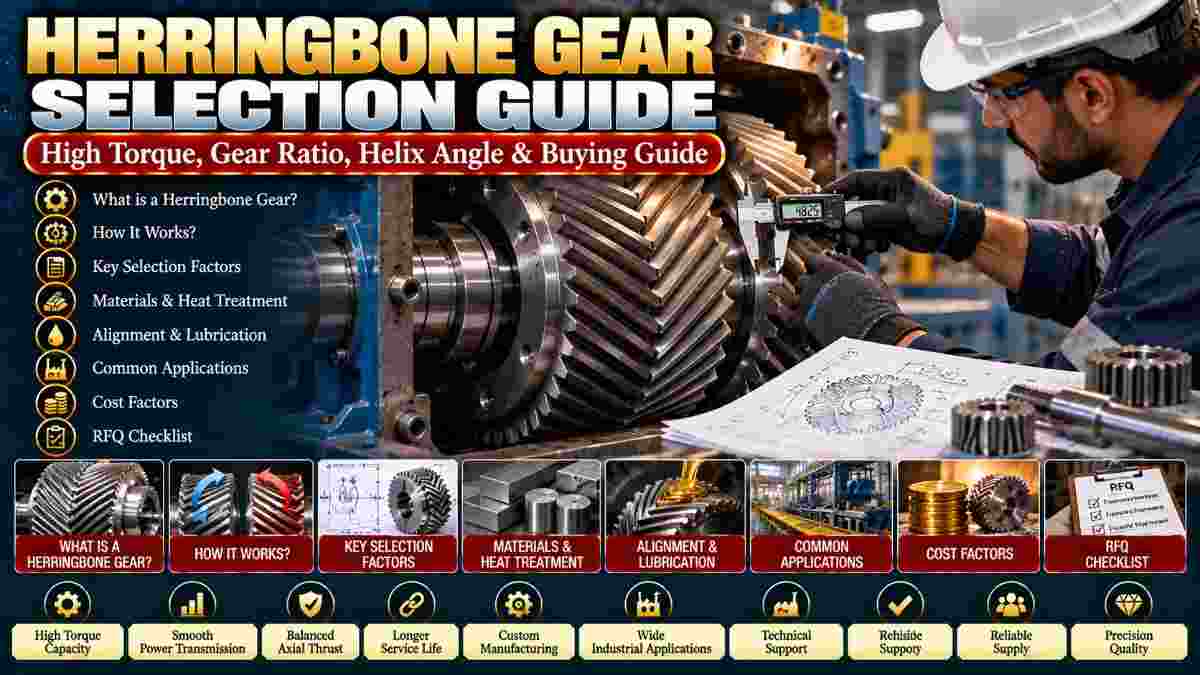
Are you sourcing herringbone gears for a heavy-duty gearbox, rolling mill, or industrial power transmission system? Incorrect gear geometry, material selection, or alignment can lead to excessive vibration, uneven tooth wear, and expensive equipment downtime.
Herringbone gear selection depends on transmitted torque, gear ratio, module, helix angle, face width, material grade, shaft dimensions, and operating conditions.
Anant Engineering offers industrial gears, including herringbone gears, for machinery and power transmission applications.
A herringbone gear is a double-helical gear featuring two sets of teeth inclined in opposite directions, forming a distinctive V-shaped pattern.
This design is commonly used for transmitting power between parallel shafts.
Typical applications include:
Steel rolling mills.
Heavy-duty reduction gearboxes.
Cement processing machinery.
Industrial crushers.
Marine power transmission equipment.
Large manufacturing machinery.
Explore Herringbone Gears for available product information.
A herringbone gear transmits rotational power through two opposing helical tooth sections that mesh with a compatible gear.
Each tooth section generates axial forces in opposite directions.
When properly designed, manufactured, and loaded, these forces largely cancel each other.
The design also supports smooth tooth engagement, making it suitable for demanding power transmission applications.
A single-helical gear has teeth inclined in one direction, while a herringbone gear combines opposing helix directions to balance axial thrust.
Single-helical gears can generate significant axial loads during operation.
Herringbone gears reduce the net axial thrust produced by the gear mesh.
However, the double-helical design is generally more complex to manufacture and inspect.
Herringbone gears are used in heavy-duty drives because their double-helical tooth arrangement can distribute transmitted loads while balancing opposing axial forces.
Potential advantages include:
High power transmission capability.
Smooth tooth engagement.
Reduced net mesh-generated axial thrust.
Suitable operation in heavy industrial gearboxes.
Reduced vibration when properly designed and aligned.
Actual performance depends on the complete gearset design and operating conditions.
The gear ratio is determined by dividing the number of teeth on the driven gear by the number of teeth on the driving gear.
For a conventional external gear pair:
Gear Ratio = Driven Gear Teeth ÷ Driving Gear Teeth
For example, a 60-tooth driven gear paired with a 20-tooth driving gear provides a 3:1 reduction ratio.
The required ratio depends on input speed and desired output speed.
Module and pressure angle determine important aspects of gear tooth size, geometry, and meshing compatibility.
Buyers should specify:
Normal or transverse module, clearly identified.
Pressure angle and its reference plane.
Number of teeth.
Gear pitch diameter.
Center distance.
Tooth geometry.
A replacement gear must match its mating gear's applicable geometry.
Do not identify a herringbone gear using outside diameter alone.
Helix angle influences tooth engagement, axial-force components, and the geometry of the double-helical arrangement.
Both opposing tooth sections must follow the approved design.
Important considerations include:
Helix angle.
Left-hand and right-hand tooth orientation.
Gear face width.
Center alignment.
Load distribution.
Incorrect geometry or alignment can prevent the opposing axial forces from balancing effectively.
Material selection depends on transmitted torque, contact stress, bending loads, wear requirements, and operating conditions.
Common options include:
Alloy steel.
Carbon steel.
Case-hardened steel.
Through-hardened steel.
Other engineered gear materials.
Heat treatment may be specified to achieve the required tooth strength and surface characteristics.
Material selection should follow approved engineering calculations.
Face width influences the available tooth contact area and the distribution of transmitted loads.
A wider gear may offer additional load-carrying potential, but only when geometry, alignment, and structural conditions are suitable.
Excessive or uneven face loading can contribute to localized wear.
The final width must be established through gear design calculations.
Gear torque can be estimated from transmitted power and rotational speed.
For metric units:
Torque (Nm) = 9550 × Power (kW) ÷ Speed (RPM)
This estimates steady-state torque at the specified shaft.
Actual gear selection must also consider shock loading, starting torque, duty cycle, and service factors.
Use the applicable design standard and manufacturer calculations for final sizing.
Correct alignment and lubrication help maintain suitable tooth contact, control friction, and reduce premature gear wear.
Important checks include:
Shaft parallelism.
Bearing condition.
Gear center distance.
Tooth contact pattern.
Lubricant viscosity.
Oil cleanliness.
Operating temperature.
Herringbone gears can experience uneven loading if the gearset is incorrectly aligned.
Follow gearbox manufacturer instructions for lubrication and inspection.
Common causes include overloading, inadequate lubrication, improper alignment, fatigue, contamination, and unsuitable tooth geometry.
Warning signs include:
Abnormal vibration.
Excessive operating noise.
Tooth pitting.
Surface scoring.
Localized wear.
Broken teeth.
Increased gearbox temperature.
Investigate the complete transmission system before replacing damaged gears.
Replacement gears must match the existing gearset's tooth geometry, dimensions, material specifications, and operating requirements.
Verify:
Gear ratio and tooth count.
Module and pressure angle.
Helix angle and tooth orientation.
Gear face width.
Center distance.
Bore and shaft dimensions.
Keyway or spline arrangement.
Material and heat treatment.
Lubrication requirements.
Existing gear drawings or samples.
Mating gear compatibility should be established before manufacturing.
Herringbone gear prices depend on size, material grade, tooth geometry, manufacturing complexity, heat treatment, inspection, and order quantity.
Special machining, gear finishing, tight tolerances, and custom shaft connections may increase production costs.
Compare quotations using identical technical specifications.
A complete quotation request should describe the required gear geometry, operating loads, materials, and inspection expectations.
Include:
Machinery application.
Motor power and input speed.
Required gear ratio.
Normal and peak torque.
Module and pressure angle.
Tooth count and helix angle.
Face width and center distance.
Shaft, bore, and keyway dimensions.
Material and heat treatment.
Required quality grade and inspection.
Technical drawings or existing samples.
Quantity and delivery destination.
Common buyer questions concern axial thrust, load capacity, materials, customization, and replacement compatibility.
Their opposing helices are designed to balance mesh-generated axial forces. Actual residual thrust depends on alignment and load distribution.
Yes, when the complete gearset is engineered for the required torque, speed, loading, and operating conditions.
The terms are often used interchangeably. More specifically, herringbone gears commonly have continuous V-shaped teeth, while some double-helical designs include a central gap.
Custom designs may be available based on approved drawings, material requirements, and manufacturing capabilities.
You can request a quotation by providing the required gear ratio, tooth geometry, transmitted torque, material specifications, shaft dimensions, and quantity.
For replacement applications, share the existing gear drawing or component sample.
Explore Herringbone Gears or visit Anant Engineering to discuss your industrial gear requirements.
Technical Note: Final gear selection must follow approved engineering calculations, applicable gear design standards, verified material properties, and operating requirements.












Anant Engineering is a leading manufacturer of high-quality industrial gears, couplings, and power transmission components. We provide precision-engineered solutions designed for maximum durability and performance across heavy industries.Our products are built to handle the most demanding industrial environments, ensuring your machinery operates with absolute accuracy and reliability. Whether you require standard gear units or custom-engineered components, we deliver the performance-based solutions your business needs to stay ahead. Partner with us today and take your industrial quality and profits to the next level!