Email Address
info@anantengineering.com
Phone Number
+91-70214-18176
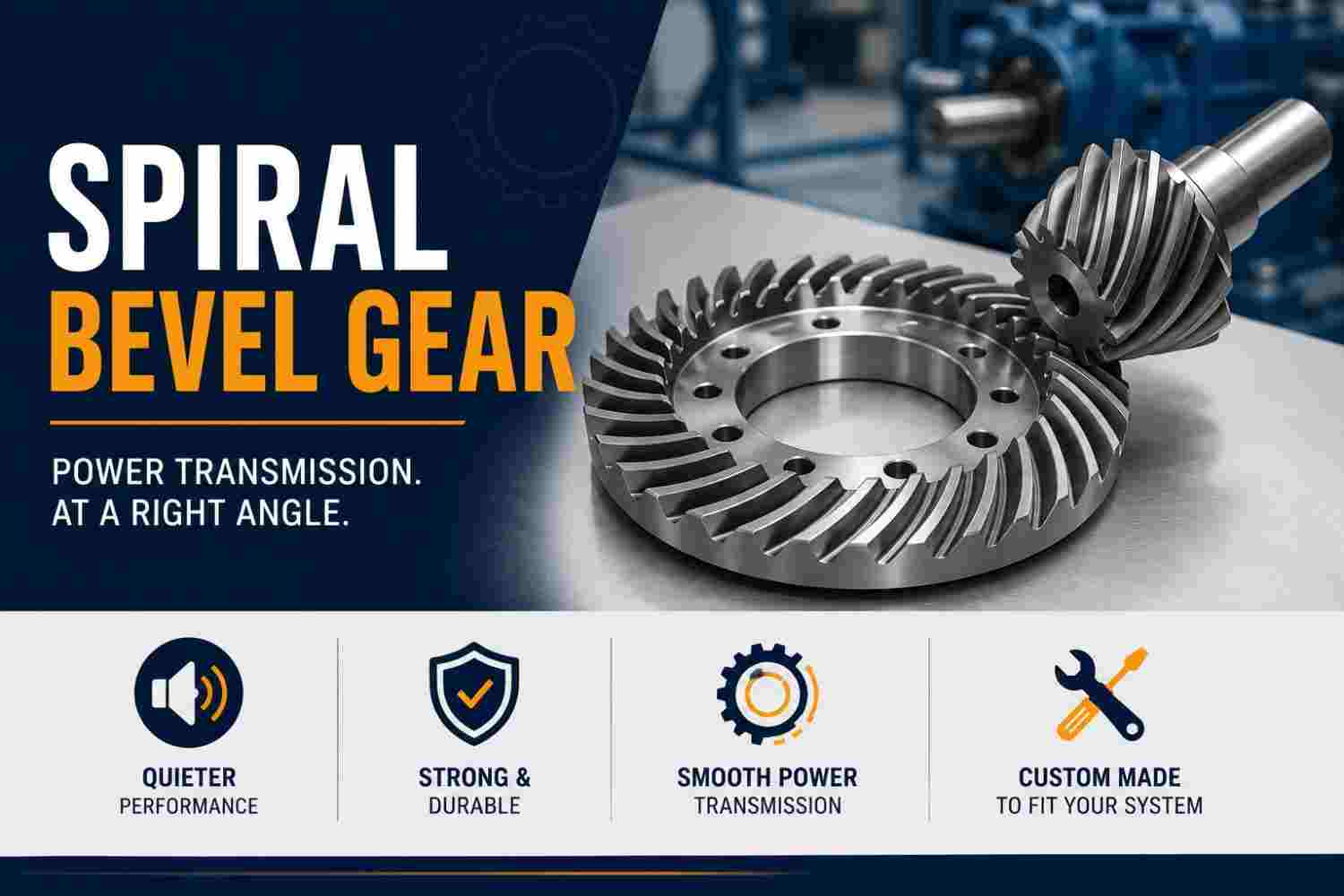
Machinery that changes direction under load runs into a predictable set of problems: vibration builds up, noise levels climb, and components start wearing out faster than expected. Engineers dealing with these issues eventually land on the same question — is there a gear that changes power direction without sacrificing smoothness or strength? The spiral bevel gear exists precisely to answer that question, and understanding why it works means walking through the problems it was built to solve.
When two shafts meet at an angle, a straight bevel gear is often the first solution engineers reach for. But straight-cut teeth engage across their full width all at once. That instant contact creates a sharp impact every time a tooth meets its pair, and at higher speeds, that impact translates directly into vibration and noise. Over time, this repeated shock also concentrates stress unevenly across the tooth surface, accelerating wear in ways that are hard to predict.
How the spiral bevel gear solves it: Its curved, angled teeth engage gradually instead of all at once. Contact builds progressively across the tooth face, which spreads the load more evenly and softens the impact that would otherwise generate noise and vibration. This is the core reason spiral bevel gears run noticeably quieter than their straight-cut counterparts, especially as rotational speed increases.
Uneven contact doesn't just create noise — it wears gears out faster. When load concentrates on a small area of the tooth rather than spreading across the full contact surface, that area fatigues and degrades well before the rest of the component shows any wear at all. This kind of localized failure is difficult to catch early and often leads to unplanned downtime.
How the spiral bevel gear solves it: The gradual engagement pattern spreads contact pressure across a wider area of the tooth surface. But this only works if manufacturing tolerances are tight — tooth curvature, spiral angle, and contact pattern all have to align precisely. Even slight misalignment during machining can undo the benefit entirely, which is why gear producers maintain close control over these parameters relative to torque requirements, shaft angle, and operating speed.
Standard gear catalogs cover common configurations, but real machinery doesn't always follow standard dimensions. A shaft angle that's slightly off, a bore size that doesn't match, or a mounting configuration unique to a legacy system can make catalog parts unusable without expensive rework elsewhere in the assembly.
How the spiral bevel gear solves it: Customization is built into how these gears are typically produced. Shaft angles, spiral angles, bore sizes, hubs, keyways, and mounting configurations can all be adjusted to match an existing system rather than forcing the system to adapt to the gear. Manufacturing from drawings or physical samples is also common, which matters when replacing a worn part in older machinery where original specifications may no longer be documented.
Surface hardness matters just as much as tooth geometry. A gear with a perfect tooth profile but soft surface material will still wear down quickly under continuous operation or heavy torque, especially in industrial gearboxes and automotive differential systems that rarely get downtime for maintenance.
How the spiral bevel gear solves it: Material selection and heat treatment address this directly. Alloy steels such as EN19, EN24, and EN353 are commonly used for higher-load applications, while case-hardening grades like 20MnCr5 add surface hardness without sacrificing the toughness of the gear's core. Controlled heat treatment further improves fatigue resistance, allowing the gear to withstand continuous operation without premature surface degradation. For moderate-duty use, carbon steel can offer a more cost-effective option without over-engineering the component.
A gear rarely fails in isolation. Excessive vibration and uneven load transfer put stress on the bearings and shafts around it, meaning a poorly performing gear can shorten the life of an entire assembly rather than just itself.
How the spiral bevel gear solves it: Because power transfer is smoother and more evenly distributed, less stress reaches the surrounding bearings and shafts. This protective effect is one of the underappreciated benefits of switching to a spiral bevel design — the reliability gain extends beyond the gear itself to the whole mechanical system it's part of.
For manufacturers and OEMs sourcing gears across multiple production runs, inconsistency between batches is a real risk. A gear that performs well in one shipment but shows dimensional drift in the next can cause failures that are difficult to trace back to the source.
How the spiral bevel gear solves it: Reliable production involves consistent checks for dimensional accuracy, hardness, and surface finish across every batch, along with heat-treated gears designed for extended service life. Compliance with recognized mechanical standards and secure packaging for logistics further reduce the risk of quality drift between orders, which matters most for buyers sourcing at scale or across international supply chains.
These problem-solving qualities are why spiral bevel gears show up consistently in heavy-duty industrial gearboxes, automotive and differential systems, mining and construction machinery, printing and packaging automation, and any power transmission unit that needs a right-angle drive. In each case, the combination of quiet operation, even load distribution, and long service life addresses the exact issues that push engineers away from straight bevel alternatives in the first place.
Before specifying a gear, it helps to have your shaft angle, torque and speed requirements, and any bore, hub, or keyway details ready. Sharing drawings or a physical sample when replacing an existing component also speeds up the process and reduces the chance of a mismatch once the part is installed.
Most of the problems that push engineers toward a redesign — noise, uneven wear, poor fit, premature failure — trace back to how a gear's teeth engage and how well its material handles sustained load. This gear type addresses each of these directly through progressive tooth engagement, precise manufacturing tolerances, and material choices matched to real operating conditions, making it a dependable option wherever power needs to change direction without losing efficiency.
Reach out to a technical team with your shaft angle, torque, and material requirements for guidance on custom gear manufacturing.













Anant Engineering is a leading manufacturer of high-quality industrial gears, couplings, and power transmission components. We provide precision-engineered solutions designed for maximum durability and performance across heavy industries.Our products are built to handle the most demanding industrial environments, ensuring your machinery operates with absolute accuracy and reliability. Whether you require standard gear units or custom-engineered components, we deliver the performance-based solutions your business needs to stay ahead. Partner with us today and take your industrial quality and profits to the next level!