Email Address
info@anantengineering.com
Phone Number
+91-70214-18176
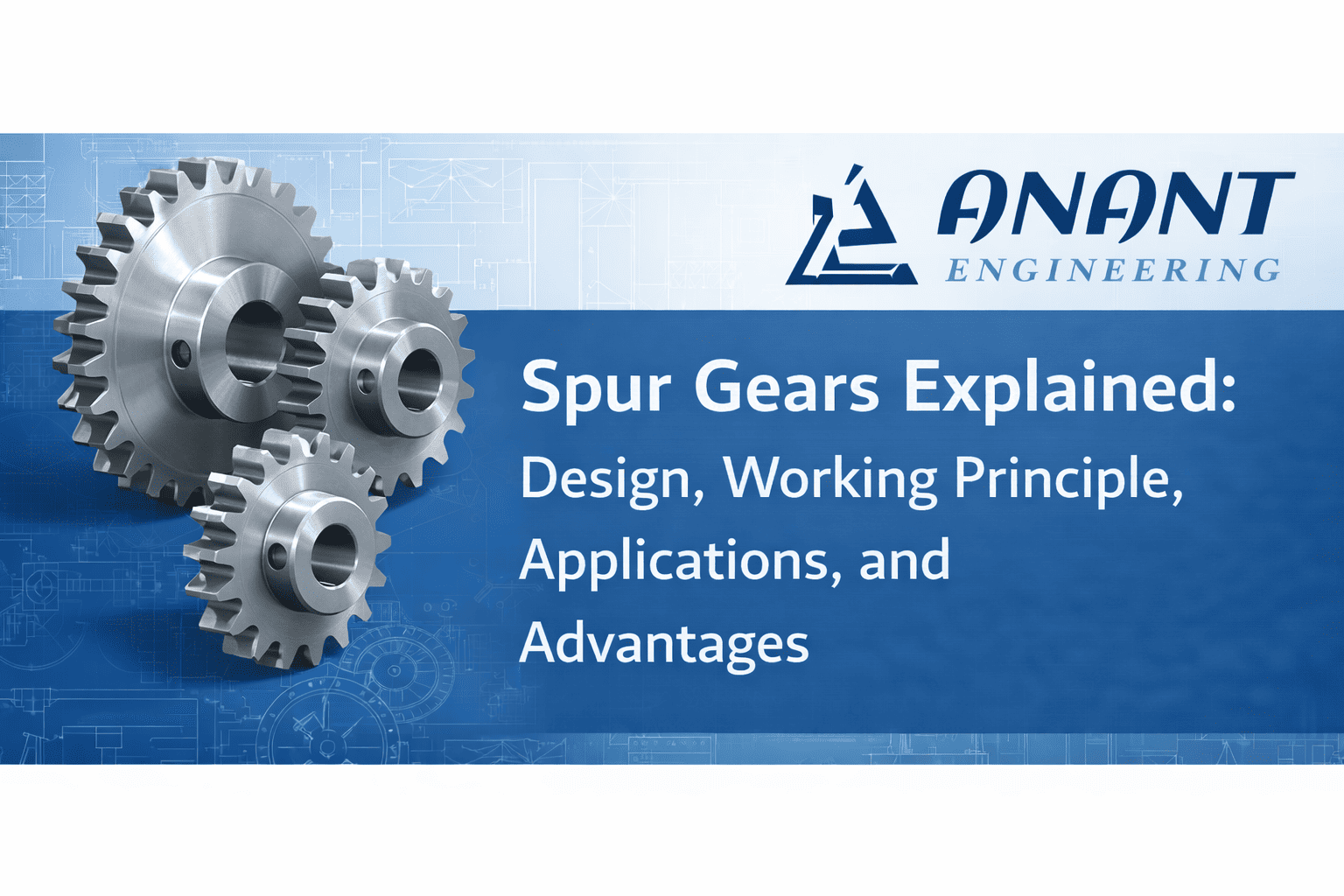
A spur gear is a cylindrical gear with straight teeth cut parallel to its rotational axis. It is used to transmit motion and power between parallel shafts. Due to its simple structure, a spur gear is easy to design, manufacture, and maintain, making it one of the most widely used gear types in mechanical systems. What This Article Covers
This article explains:
Spur gears are preferred across industries because they offer:
Their straightforward tooth design allows predictable motion transfer, which is ideal for standard machinery and industrial equipment.
Spur gears have been used since ancient times in devices such as water wheels and mechanical clocks. With advancements in metallurgy, machining accuracy, and CAD-based design, modern spur gears are now highly precise and capable of handling heavy industrial loads.
Industrial spur gears play a crucial role in power transmission systems like gearboxes, conveyors, pumps, compressors, and machine tools. Their strength, durability, and efficiency make them essential components in manufacturing and automation industries.
The spur gear working principle is based on direct tooth-to-tooth contact. When the driving gear rotates, its teeth mesh with the teeth of the driven gear, transferring torque and rotational motion between parallel shafts.
This simple mechanism ensures accurate and efficient motion transfer.
Spur gears are highly efficient, often achieving 95–98% efficiency due to minimal sliding action. They perform best in low to moderate speed applications where smooth operation is required.
Despite their efficiency, spur gears have drawbacks:
For these reasons, they are less suitable for high-speed or silent operations. Diagrams of meshing gears and pitch circles are commonly used to explain this principle visually in engineering references.
Effective spur gear design depends on several critical parameters:
Each element directly influences performance and durability.
Common spur gear materials include:
Industrial spur gears often use hardened or alloy steel for heavy-duty power transmission.
When designing spur gears, engineers consider:
A well-optimized spur gear design improves efficiency, reduces wear, minimizes noise, and significantly extends operational lifespan.
Spur gears are available in several forms, each designed to meet specific mechanical and operational requirements. Understanding the types of spur gears helps in selecting the right gear for efficiency, durability, and performance.
External spur gears are the most common type. Their teeth are cut on the outer surface of a cylindrical body and mesh with another external spur gear. They are widely used in gearboxes, industrial machines, and mechanical drives where parallel shafts are required.
Internal spur gears have teeth cut on the inner surface of a ring-shaped gear. They usually mesh with an external spur gear. This type allows compact designs and smoother operation and is commonly used in planetary gear systems and specialized industrial equipment.
A rack and pinion system consists of a round spur gear (pinion) meshing with a straight linear gear (rack). It converts rotational motion into linear motion and is commonly used in steering systems, CNC machines, and lifting mechanisms.
The correct type depends on load, speed, space constraints, noise tolerance, and application environment. Industrial buyers often prioritize durability and load capacity, while precision systems focus on accuracy and smooth operation.
The wide usability of spur gears is reflected in their presence across multiple sectors. Spur gear applications range from heavy machinery to everyday household devices.
Spur gears are extensively used in:
Their reliability and efficiency make industrial spur gears ideal for continuous-duty operations.
In the automotive industry, spur gears are used in:
They provide precise motion control and consistent torque transmission.
Spur gears play a key role in conveyors, elevators, and material handling equipment. Their ability to transmit power reliably at constant speeds makes them suitable for factory automation and logistics systems.
Robots and automated machinery rely on precision spur gears for accurate positioning and repeatable motion. Their predictable gear ratios ensure controlled movement.
From washing machines and mixers to printers and clocks, spur gears are commonly used due to their compact size, low cost, and dependable performance.
Overall, industrial spur gears are preferred because of their simplicity, strength, and ease of maintenance, especially in demanding operating environments.
Like any mechanical component, spur gears have strengths and limitations. Understanding the spur gear advantages and disadvantages helps in making the right design or purchase decision.
These advantages make spur gears a practical choice for many mechanical systems.
Because of these limitations, spur gears are not ideal for high-speed or ultra-silent applications.
Spur gears remain one of the most important components in mechanical engineering due to their simple design, high efficiency, and wide range of applications. From understanding spur gear design and working principles to exploring real-world industrial spur gear applications, it’s clear why they continue to be widely used.
Choosing the right spur gear depends on factors such as load, speed, noise requirements, and operating conditions. While spur gears excel in efficiency and cost-effectiveness, comparing them with alternatives like helical gears ensures the best performance for your application.
For reliable power transmission and long-term performance, selecting the correct spur gear type and material is essential. Consulting experienced manufacturers or exploring proven industrial spur gear solutions can help achieve optimal results in any mechanical system.












Anant Engineering is a leading manufacturer of high-quality industrial gears, couplings, and power transmission components. We provide precision-engineered solutions designed for maximum durability and performance across heavy industries.Our products are built to handle the most demanding industrial environments, ensuring your machinery operates with absolute accuracy and reliability. Whether you require standard gear units or custom-engineered components, we deliver the performance-based solutions your business needs to stay ahead. Partner with us today and take your industrial quality and profits to the next level!