Email Address
info@anantengineering.com
Phone Number
+91-70214-18176
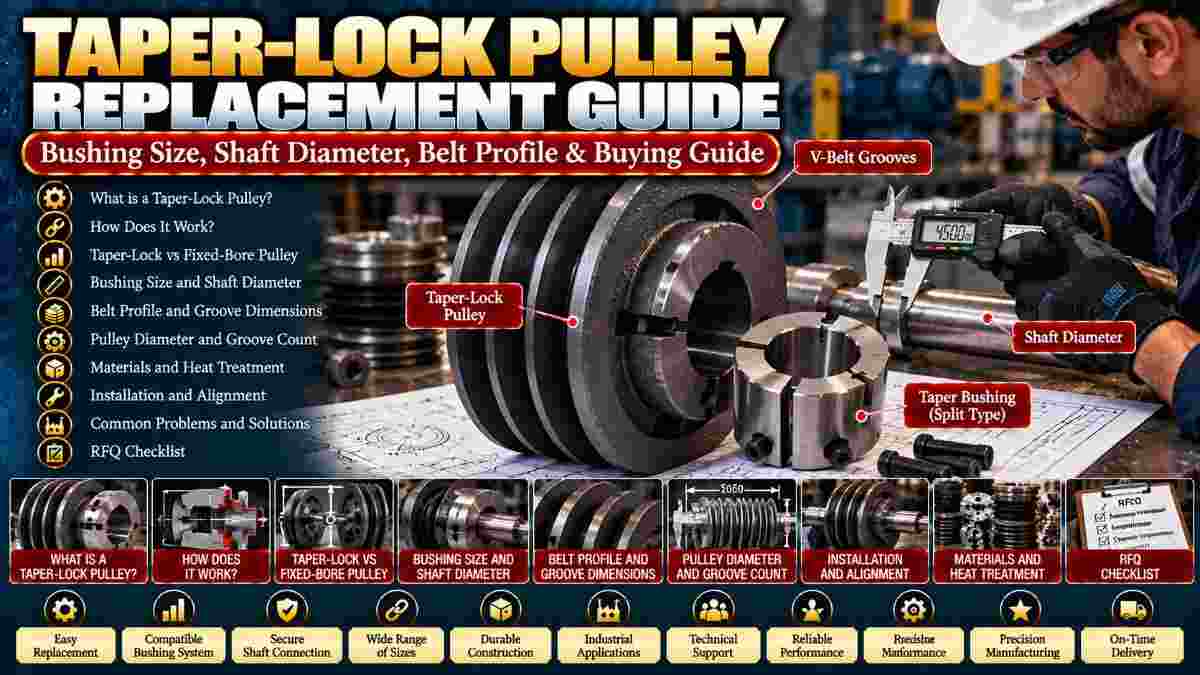
Are you replacing a worn pulley on an industrial motor, conveyor, compressor, or ventilation system? An incorrect pulley or taper bushing can cause belt misalignment, vibration, shaft damage, and unexpected downtime.
Taper-lock pulley replacement specifications should include belt profile, pulley diameter, groove count, bush series, shaft diameter, keyway dimensions, operating speed, and transmitted load.
Anant Engineering offers industrial pulleys for power transmission and machinery applications.
A taper-lock pulley is a belt pulley designed to mount onto a shaft using a compatible tapered split bushing and locking screws.
The bushing grips the shaft as it is drawn into the pulley's tapered hub.
Common applications include:
Industrial fans and blowers.
Pumps and compressors.
Conveyor drives.
Textile machinery.
Processing equipment.
Explore Taper Lock Pulleys for product information.
A taper-lock bushing creates a secure shaft connection when tightening screws draw its tapered surface into the matching pulley hub.
The tapered fit generates radial clamping pressure around the shaft.
Correct shaft dimensions, bush compatibility, surface condition, and tightening torque are essential.
The assembly must be installed according to its manufacturer's instructions.
A taper-lock pulley uses a removable bushing, while a fixed-bore pulley has a shaft opening machined directly into its hub.
Taper-lock arrangements can simplify replacement and accommodate different shaft sizes within the compatible pulley and bushing system.
Fixed-bore pulleys may use keys, set screws, or other approved securing methods.
Neither arrangement should be substituted without checking mechanical compatibility.
Identify the existing bushing series and bore size using its marking, manufacturer catalog, and measured shaft dimensions.
Check:
Bushing series designation.
Shaft bore diameter.
Keyway dimensions.
Tapered hub compatibility.
Bushing length.
Locking screw arrangement.
Common bushing designations include 1008, 1210, 1610, and other series.
The series designation and bore size are separate specifications.
Shaft diameter determines the required bushing bore and affects the security of the pulley-to-shaft connection.
Measure the shaft at the intended mounting position.
Inspect for:
Surface damage.
Corrosion.
Excessive wear.
Dimensional variation.
Damaged keyways.
Use approved tolerances rather than selecting a bushing based on an approximate measurement.
Pulley diameter should match the drive's required speed ratio, belt system, and equipment design.
For a conventional belt drive without significant slip:
Driven RPM ≈ Driving RPM × Driving Pitch Diameter ÷ Driven Pitch Diameter
Actual speed depends on the belt-drive design and operating conditions.
Use the appropriate pitch or datum diameter specified for the belt system.
Do not rely only on the pulley's measured outside diameter.
Belt profile and groove dimensions must match the selected belt to maintain proper contact and power transmission.
Check:
V-belt section.
Groove profile.
Groove spacing.
Groove count.
Pulley datum diameter.
Belt manufacturer's specifications.
Explore V Belt Pulleys for related product information.
An incompatible groove may cause excessive belt wear or improper seating.
The required groove count depends on transmitted power, belt type, operating speed, and the overall belt-drive design.
Single-groove pulleys may suit selected lower-power applications.
Multi-groove arrangements distribute power transmission across multiple compatible belts.
The number of grooves should follow approved drive calculations.
Pulley material should be selected according to mechanical loading, operating speed, environmental conditions, and construction requirements.
Common options include:
Cast iron.
Mild steel.
Fabricated steel.
Other application-specific materials.
Anant Engineering lists cast iron and steel configurations among its pulley products.
Confirm available materials and balancing requirements before ordering.
Alignment and balancing help limit vibration, belt wear, bearing loads, and unstable operation.
Important checks include:
Shaft parallelism.
Pulley groove alignment.
Axial positioning.
Bearing condition.
Pulley runout.
Operating RPM.
High-speed applications may require additional balancing according to the equipment specifications.
Installation requires clean mating surfaces, a compatible bushing, correct screw placement, and tightening to the manufacturer's specified torque.
A general process includes:
Isolate and lock out the machinery.
Inspect the shaft, pulley, and bushing.
Clean the tapered mating surfaces.
Align the bushing and hub holes.
Position the assembly on the shaft.
Install the required key, if specified.
Tighten screws evenly to the approved torque.
Verify alignment and follow the required post-installation checks.
Do not lubricate tapered mating surfaces unless the specific manufacturer explicitly requires it.
Some instructions permit light lubrication of screw threads; this is different from lubricating the taper.
Common causes include incorrect bushing selection, inadequate tightening, poor alignment, excessive loads, contamination, and worn belts.
Warning signs include:
Pulley movement on the shaft.
Unusual vibration.
Cracked hub components.
Excessive belt wear.
Loose fasteners.
Damaged keyways.
Inspect the complete drive assembly when investigating recurring failures.
Replacement pulleys must match the existing belt system, mounting arrangement, operating load, and required dimensions.
Record the pulley model, groove profile, groove count, diameter, bushing series, shaft size, keyway, overall width, and material.
Photographs and technical drawings can help identify the correct component.
Prices depend on pulley diameter, material, groove count, bushing requirements, machining, balancing, and quantity.
Custom dimensions, specialized finishes, and inspection documentation may also influence cost.
Compare quotations with the bushing supply clearly included or excluded.
A complete quotation request should identify the pulley, bushing, belt, shaft connection, and operating conditions.
Provide:
Machine application.
Motor power and RPM.
Required pulley diameter.
Belt profile and groove count.
Bushing series and bore size.
Shaft diameter and keyway.
Hub and overall dimensions.
Pulley material.
Operating load and speed.
Balancing requirements.
Existing drawings or samples.
Quantity and delivery location.
Buyers commonly ask about bushing compatibility, replacement, alignment, and installation.
Yes, if the pulley remains serviceable and the replacement bushing is fully compatible.
No. The bushing series, taper geometry, bore, and mounting arrangement must match.
Some installations use keyed shaft connections. Follow the selected pulley and bushing manufacturer's instructions.
Custom groove arrangements, diameters, materials, and other dimensions may be available depending on manufacturing capabilities.
The tapered mating surfaces are normally installed clean and dry. Follow the specific manufacturer's instructions for screw preparation.
You can request a quotation by sharing your pulley dimensions, belt profile, bushing designation, shaft measurements, operating requirements, and quantity.
For replacement applications, include photographs or an approved drawing.
Explore Taper Lock Pulleys or contact Anant Engineering to discuss your requirements.
Technical Note: Final component selection, installation torque, belt tension, and alignment must follow the relevant equipment and component manufacturers' instructions.













Anant Engineering is a leading manufacturer of high-quality industrial gears, couplings, and power transmission components. We provide precision-engineered solutions designed for maximum durability and performance across heavy industries.Our products are built to handle the most demanding industrial environments, ensuring your machinery operates with absolute accuracy and reliability. Whether you require standard gear units or custom-engineered components, we deliver the performance-based solutions your business needs to stay ahead. Partner with us today and take your industrial quality and profits to the next level!