Email Address
info@anantengineering.com
Phone Number
+91-70214-18176
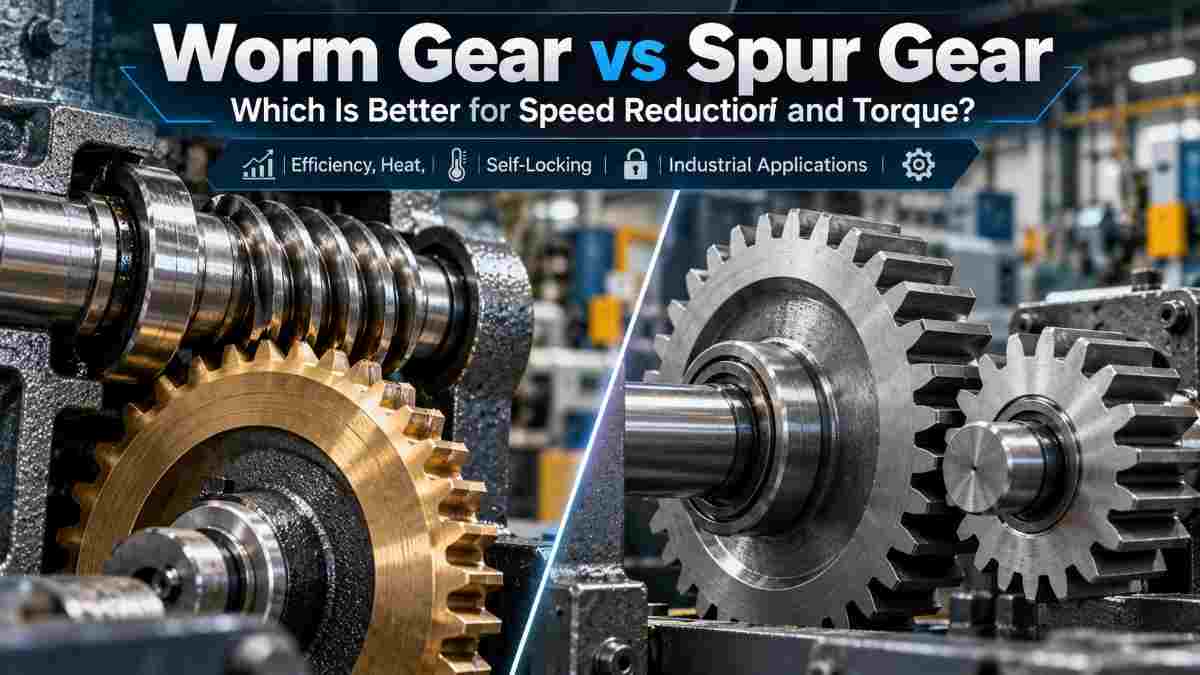
Worm gears and spur gears are both widely used in industrial power transmission, but they are designed for very different mechanical requirements.
A worm gear is typically selected when machinery needs high speed reduction, compact right-angle power transmission, controlled motion, or self-locking behaviour. A spur gear, on the other hand, is commonly used when straightforward, efficient power transmission between parallel shafts is required.
Anant Engineering manufactures both worm gears and spur gears for industrial applications. Choosing the right one depends on speed, torque, shaft orientation, efficiency, load, and operating conditions.
A worm gear system consists of a screw-like component called the worm and a mating gear known as the worm wheel.
The worm rotates and drives the wheel, usually transmitting motion between shafts positioned at approximately 90 degrees to one another.
Worm gears are commonly selected for applications that require:
Anant Engineering's worm gear range is designed for applications such as lifting equipment, conveyors, positioning systems, valve drives, automation machinery, and industrial gearboxes.
A spur gear is a cylindrical gear with straight teeth positioned parallel to the axis of rotation.
Two spur gears mesh directly to transmit power between parallel shafts.
Their simple geometry makes them one of the most widely used industrial gear types.
Spur gears are commonly used when machinery requires:
For machines that need straightforward parallel-shaft transmission, Anant Engineering's spur gears provide a practical solution.
The main difference is the way the two systems transmit motion.
A worm gear typically transfers power between non-parallel shafts, while spur gears transmit power between parallel shafts.
Their operating characteristics also differ in terms of:
This means the best choice depends on the actual mechanical objective rather than simply choosing one gear type as universally better.
Worm gears are generally better suited to high reduction ratios in a compact arrangement.
A single worm gear stage can provide substantial speed reduction because the ratio depends on the number of worm starts and the number of teeth on the worm wheel.
Spur gears can also reduce speed, but large reductions may require multiple gear stages.
This makes worm gears especially useful where space is limited and the output needs to rotate much more slowly than the input.
Both gear types can increase torque when speed is reduced.
Worm gears are often associated with high torque multiplication because they can achieve large reduction ratios in one stage.
Spur gears can also transmit high torque effectively, especially when properly sized and manufactured from suitable materials.
For a complete industrial transmission system, businesses may also evaluate broader industrial gear options according to load, shaft arrangement, speed, and duty cycle.
Spur gears are generally more mechanically efficient because their teeth engage primarily through rolling contact.
Worm gears experience more sliding contact between the worm and wheel.
This sliding action creates additional friction, which can reduce efficiency and generate more heat.
For machines where maximum transmission efficiency is the primary goal, spur gears are often preferable.
The main reason is sliding friction.
As the worm rotates against the worm wheel, significant sliding occurs between the mating surfaces.
This converts some mechanical energy into heat.
Excessive heat may lead to:
Proper material pairing, lubrication, surface finish, and load control are therefore particularly important in worm gear applications.
Spur gears can be suitable for relatively high-speed transmission when noise and vibration are properly controlled.
Because they are efficient and mechanically simple, they are widely used in machines where speed needs to be transmitted directly between parallel shafts.
Worm gears are typically more appropriate where controlled reduction is more important than high-speed output.
The exact choice should still consider gear size, tooth quality, balancing, lubrication, and load.
Worm gears are often well suited to low-speed, high-torque systems.
The high reduction ratio allows a relatively fast motor input to produce a much slower output with increased torque.
This is useful in:
Some worm gear configurations can provide self-locking behaviour.
This means the worm can rotate the worm wheel, while the wheel may not easily rotate the worm in reverse.
This feature is particularly useful in machinery where the load must remain in position when driving power is removed.
However, self-locking depends on factors such as:
Self-locking should therefore be confirmed for the specific gear design rather than assumed for every worm gear.
No, standard spur gears do not normally provide self-locking behaviour.
If force is applied to the driven gear, the system can generally transmit motion back toward the driving gear.
Where reverse movement must be prevented, an additional brake, locking mechanism, or another suitable transmission design may be required.
Worm gears can provide a strong advantage when a large reduction ratio must fit into a relatively small installation area.
The 90-degree shaft arrangement can also simplify machine layouts where the input and output shafts cannot be positioned along the same direction.
Spur gear systems can be compact for simple ratios, but larger reductions may require additional gears and more space.
Spur gears generally have simpler tooth geometry than worm gears.
Their straight teeth make manufacturing, inspection, and maintenance relatively straightforward.
Worm gear systems require accurate control of factors such as:
Small manufacturing errors in a worm gear set can increase friction, heat, and wear.
Worm gears generally require more careful lubrication because of their higher sliding friction.
The lubricant must create a protective film between the worm and wheel to reduce wear and heat generation.
Spur gears also require lubrication, especially under high loads and speeds, but their rolling tooth contact usually creates less friction.
Material pairing is especially important in worm gear systems.
The worm is commonly made from hardened or alloy steel, while the worm wheel may use materials such as bronze or gunmetal.
This combination can help reduce friction and wear.
Anant Engineering manufactures worm gears using options such as alloy steels including EN19 and EN24 for worms, with phosphor bronze or gunmetal commonly used for worm wheels.
Spur gears can be manufactured from a wide range of materials depending on load, speed, wear, noise, and operating environment.
Common choices include:
The correct material depends on the operating load and expected service conditions.
Worm gears can provide relatively smooth and quiet motion because engagement between the worm and wheel is gradual.
Spur gears can produce more noticeable noise at higher speeds because the straight teeth engage more directly.
However, noise also depends on:
Worm gears are frequently used where controlled motion and large reduction ratios are required.
Typical applications include:
Spur gears are used across a broad range of machinery because of their simple and efficient design.
Applications include:
Common causes of worm gear failure include:
Regular inspection and appropriate lubrication can help reduce premature failure.
Spur gears may fail because of:
Correct load calculations and material selection are essential for long gear life.
Start by identifying the most important requirements of the machine.
Consider:
Choose a worm gear when you need large speed reduction, compact right-angle power transmission, smooth low-speed motion, or self-locking capability.
Choose a spur gear when your priority is simple, efficient, direct transmission between parallel shafts.
Neither gear is universally better.
Worm gears are better suited to high reduction ratios, compact right-angle drives, controlled motion, and some self-locking applications.
Spur gears are better suited to efficient power transfer, simple construction, parallel shafts, and applications where low friction is important.
Anant Engineering manufactures worm gears, spur gears, and a wider range of industrial gears for different speed, torque, load, and power transmission requirements.
Selecting the correct gear type according to shaft arrangement, ratio, torque, and duty cycle can help improve machine efficiency and extend component life.













Anant Engineering is a leading manufacturer of high-quality industrial gears, couplings, and power transmission components. We provide precision-engineered solutions designed for maximum durability and performance across heavy industries.Our products are built to handle the most demanding industrial environments, ensuring your machinery operates with absolute accuracy and reliability. Whether you require standard gear units or custom-engineered components, we deliver the performance-based solutions your business needs to stay ahead. Partner with us today and take your industrial quality and profits to the next level!