Email Address
info@anantengineering.com
Phone Number
+91-70214-18176
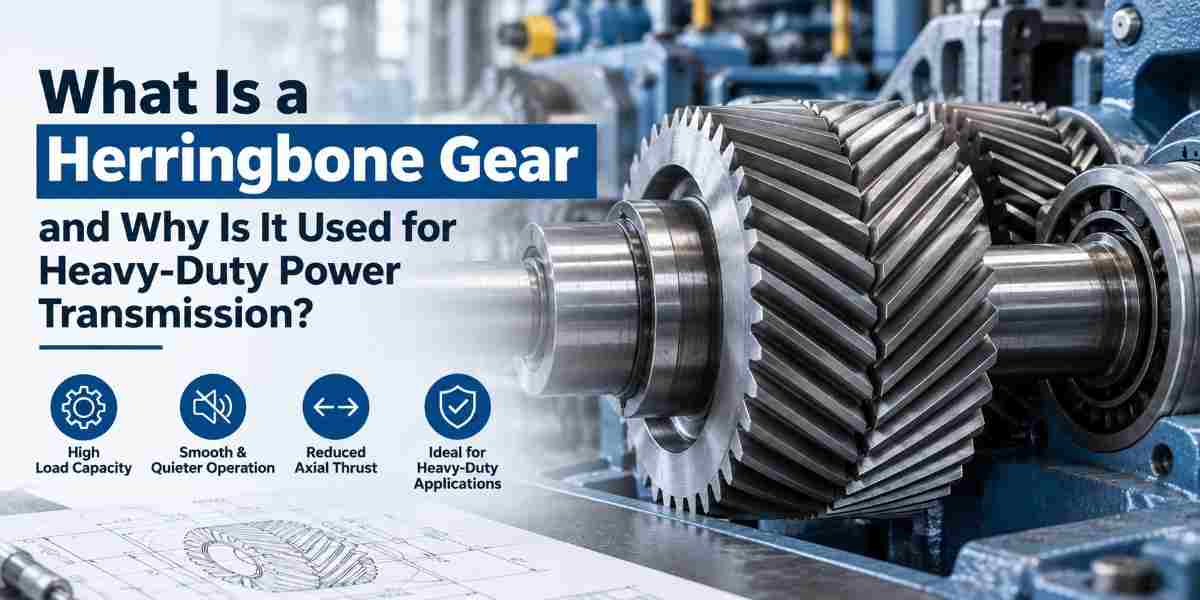
Heavy-duty machinery requires gears that can transmit large amounts of power smoothly while controlling vibration, noise, and axial load. Herringbone gears are designed for exactly this type of demanding application.
A herringbone gear uses two sets of angled teeth arranged in opposite directions, creating a V-shaped tooth pattern. This design combines the smooth engagement of helical gears with the added benefit of cancelling much of the axial thrust that would normally be generated by angled teeth.
Anant Engineering manufactures herringbone gears along with helical gears, gear shafts, and other industrial gears for demanding power transmission applications.
A herringbone gear is a type of double helical gear with two sets of helical teeth cut in opposite directions on the same gear body.
The tooth arrangement forms a V-shaped or herringbone pattern across the face of the gear.
This geometry allows the gear to transmit high loads while reducing the axial thrust produced by a conventional single helical gear.
When two herringbone gears mesh, the angled teeth on one half of the gear engage in one direction while the teeth on the other half engage in the opposite direction.
The axial force generated by one side is opposed by the axial force from the other side.
This helps balance thrust while still allowing gradual tooth engagement and smooth power transmission.
A herringbone gear is often described as a double helical gear because it combines two helical tooth sections with opposite helix angles.
Instead of having teeth angled only in one direction, the gear uses a mirrored arrangement.
This gives it many of the same advantages as a helical gear while reducing the axial forces associated with single-helical designs.
The main difference is the direction of the teeth.
A standard helical gear has teeth angled in one direction across the face of the gear.
A herringbone gear has two sets of helical teeth arranged in opposite directions.
Anant Engineering also manufactures helical gears for applications where smooth engagement, high load capacity, and efficient power transmission are required.
Single helical gears generate axial force because the teeth are angled relative to the shaft axis.
In a herringbone gear, one set of teeth produces thrust in one direction while the opposite set produces thrust in the other direction.
These forces largely cancel each other, reducing the need for heavy thrust bearings in many applications.
Herringbone gears are well suited to heavy-duty machinery because they combine high load capacity with smooth tooth engagement.
Their broad face width and double-helical geometry allow load to be distributed across a larger contact area.
This can help provide:
Herringbone gears are commonly used in industries where machinery operates under high loads and long duty cycles.
Typical applications include:
The double-helical tooth arrangement increases the effective contact area between mating gears.
This helps distribute the transmitted load over more tooth surface.
As a result, herringbone gears can be suitable for applications where large amounts of torque must be transmitted continuously.
Herringbone gears generally provide smoother and quieter operation than spur gears.
Spur gear teeth engage more directly, while herringbone teeth engage gradually because of their angled geometry.
This gradual engagement can reduce impact, vibration, and noise during operation.
Spur gears are simpler and easier to manufacture, but they are not always the best choice for very high-load or high-speed applications.
Herringbone gears provide:
Spur gears remain suitable for simpler transmission systems, while herringbone gears are often preferred for demanding industrial applications.
Herringbone gears are commonly manufactured from high-strength materials because they are frequently used in heavy-duty equipment.
Typical materials may include:
The final material selection depends on torque, speed, temperature, expected service life, and operating environment.
Heat treatment can improve surface hardness, wear resistance, and fatigue strength.
Depending on the application, processes may include:
The goal is to create teeth strong enough to resist wear while maintaining sufficient core toughness.
Proper alignment is critical for any high-load gear system.
Misalignment can cause uneven tooth contact across the gear face.
This may result in:
Both the shafts and bearing supports must maintain accurate positioning under operating load.
The gear shaft supports the rotating gear and transmits torque through the drive system.
A shaft used with heavy-duty herringbone gearing must be capable of handling:
Anant Engineering manufactures gear shafts for industrial power transmission systems where strength and dimensional accuracy are important.
The terms are often used interchangeably, but some double-helical gears include a central gap between the two helical sections.
Traditional herringbone gears may have the two tooth directions meeting near the centre without a large groove.
The exact manufacturing style depends on design requirements and production methods.
The V-shaped tooth geometry is more complex than straight or single-helical teeth.
Manufacturing requires careful control of:
Accurate manufacturing is important because even small errors can affect load distribution and tooth contact.
Proper lubrication reduces friction, controls temperature, and helps protect the gear teeth from wear.
Poor lubrication can lead to:
The lubricant should match the load, speed, operating temperature, and gearbox conditions.
Common causes of failure include:
Routine inspection and condition monitoring can help identify developing problems before they lead to unplanned downtime.
Common warning signs include:
Early inspection can help determine whether the cause is wear, misalignment, lubrication, or loading.
Gear life can be improved through correct design, installation, and maintenance.
Important practices include:
A herringbone gear may be a strong choice when machinery needs to transmit high torque continuously while minimizing axial thrust and maintaining smooth operation.
It is especially suitable when:
Before placing an order, confirm technical requirements such as:
Accurate specifications help ensure that the gear matches the machine and expected operating load.
Herringbone gears are used in heavy-duty power transmission because their double-helical tooth arrangement combines high load capacity, smooth engagement, and reduced axial thrust.
This makes them well suited to large industrial drives where reliability, torque capacity, and long operating life are important.
Anant Engineering manufactures herringbone gears, helical gears, gear shafts, and other industrial gears for different power transmission requirements.
Selecting the correct material, tooth geometry, shaft design, heat treatment, and lubrication can help improve performance and extend the service life of a heavy-duty gear system.













Anant Engineering is a leading manufacturer of high-quality industrial gears, couplings, and power transmission components. We provide precision-engineered solutions designed for maximum durability and performance across heavy industries.Our products are built to handle the most demanding industrial environments, ensuring your machinery operates with absolute accuracy and reliability. Whether you require standard gear units or custom-engineered components, we deliver the performance-based solutions your business needs to stay ahead. Partner with us today and take your industrial quality and profits to the next level!