Email Address
info@anantengineering.com
Phone Number
+91-70214-18176
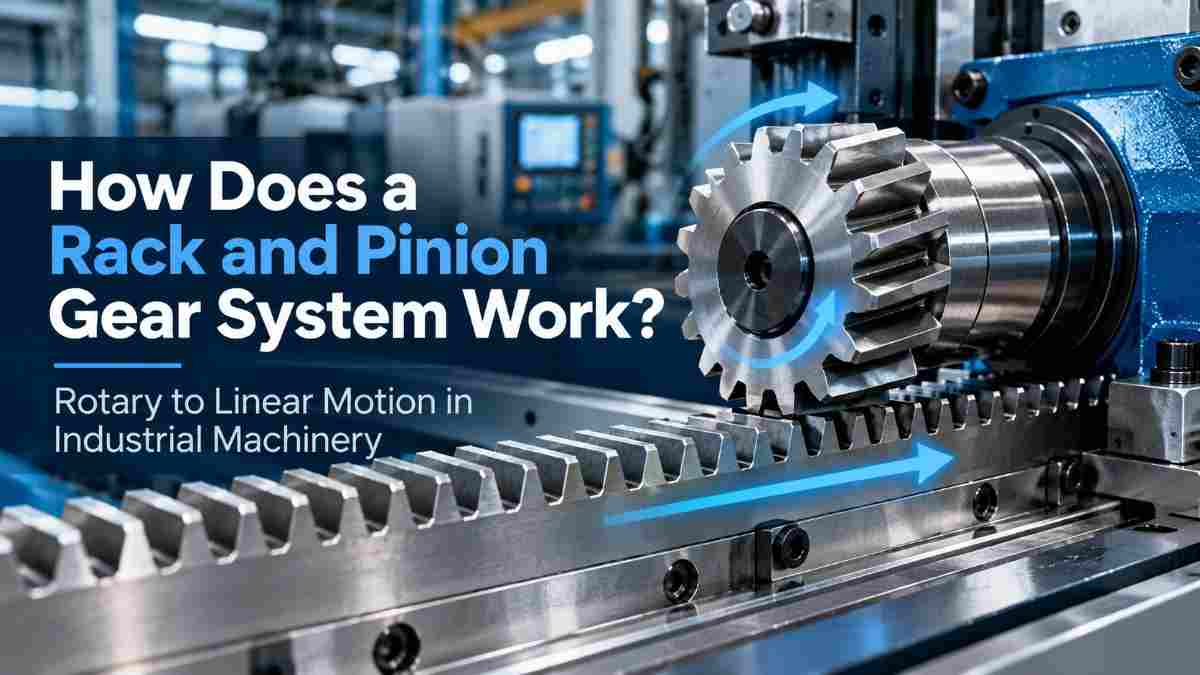
A rack and pinion gear system is used when rotary motion needs to be converted into straight-line movement. It is a simple but highly effective mechanical arrangement used in industrial machinery, automation systems, steering mechanisms, lifting equipment, and positioning applications.
The system consists of two main components: a round gear called the pinion and a straight toothed bar called the rack. As the pinion rotates, its teeth engage with the rack and move it in a linear direction.
Anant Engineering manufactures rack gears, pinion gears, and other industrial gears for applications that require controlled movement, positioning, and power transmission.
A rack and pinion gear system consists of a circular pinion gear that meshes with a straight rack containing matching teeth.
When the pinion rotates, the rack moves in a straight line. The system can also work in reverse, where linear movement of the rack causes the pinion to rotate.
This makes rack and pinion systems useful for converting:
The working principle is based on direct tooth engagement.
As the pinion rotates, each tooth pushes against the corresponding rack tooth. This forces the rack to move along a straight path.
The amount of linear movement depends on:
A larger pinion can move the rack farther per revolution, while a smaller pinion can provide finer movement and higher mechanical advantage.
The rack is a straight gear, while the pinion is a circular gear.
The rack provides the linear path, while the pinion supplies or receives rotary motion.
Both components must have compatible tooth geometry to operate correctly.
Anant Engineering supplies rack gears for industrial applications where reliable linear movement and accurate power transmission are required.
The pinion rotates around its shaft while its teeth remain engaged with the rack.
Because the rack cannot rotate like a circular gear, the rotational force of the pinion pushes the rack sideways.
This creates controlled linear displacement.
The principle is commonly used where a motor or gearbox needs to move equipment along a straight axis.
Rack and pinion systems are used across a wide range of industries.
Common applications include:
They are particularly useful when machinery requires direct and predictable linear motion.
Rack and pinion drives offer several practical advantages.
These include:
Unlike screw-based systems, rack and pinion drives can also be used over very long travel distances.
The gear module defines the size of the gear teeth.
Both the rack and pinion must have the same module for proper meshing.
A larger module generally means larger and stronger teeth, which can handle greater loads.
A smaller module allows more compact gearing and finer movement.
Module selection should therefore be based on:
Pinion diameter has a direct effect on how far the rack moves during each revolution.
A larger pinion produces greater linear movement per revolution, while a smaller pinion produces less movement.
This relationship affects both speed and torque.
A larger pinion can increase linear speed, while a smaller pinion can provide greater mechanical advantage.
The linear distance moved by the rack depends on the circumference of the pinion's pitch circle.
A simplified relationship is:
Rack Travel per Revolution = π × Pinion Pitch Diameter
This means a pinion with a larger pitch diameter moves the rack farther with each complete revolution.
For precise industrial applications, gear module, tooth count, pitch diameter, and backlash should all be considered.
Backlash is the small amount of clearance between mating gear teeth.
Some clearance is necessary to allow smooth movement and lubrication, but excessive backlash can reduce positioning accuracy.
Too much backlash may result in:
Precision applications may require specially controlled backlash or preload mechanisms.
Backlash can be reduced through accurate manufacturing, alignment, and system design.
Common approaches include:
However, completely eliminating clearance can increase friction and wear, so the system should maintain the correct operating allowance.
Rack and pinion systems can be manufactured from different materials depending on the application.
Common materials include:
Heavy-duty industrial applications often use hardened steel because of its strength and wear resistance.
Heat treatment may be used when the rack needs to handle high loads, frequent operation, or abrasive conditions.
Hardened teeth can improve:
The required hardness depends on operating load, speed, duty cycle, and mating pinion material.
Proper lubrication reduces friction between the rack and pinion teeth.
Without adequate lubrication, the system may experience:
Lubrication should be selected according to gear material, load, speed, and environmental conditions.
Common causes of wear include:
Regular inspection can help detect uneven tooth contact or wear before it leads to major failure.
The rack and pinion must be aligned correctly to ensure proper tooth contact.
Misalignment can cause the pinion to contact only one side of the rack teeth.
This may lead to:
The mounting surface should therefore be straight and rigid enough to maintain alignment throughout the full travel distance.
Both systems can produce linear motion, but they work differently.
A rack and pinion uses meshing gear teeth, while a lead screw converts rotation into movement through a threaded screw and nut.
Rack and pinion systems are often better for:
Lead screws can be useful where fine movement, compact design, or self-locking behavior is required.
Yes. This is one of their major advantages.
Rack sections can be joined together to create long linear travel systems.
This makes rack and pinion drives useful in large CNC machines, gantry systems, industrial automation, and material handling equipment.
Yes. A motor can drive the pinion directly or through a gearbox when lower speed and higher torque are required.
The gearbox helps adjust the output speed and torque before power reaches the pinion.
The full transmission system may also incorporate gear shafts or other industrial gear components depending on the machine design.
A gear shaft can support or transmit rotational power to the pinion.
The shaft must be designed to handle:
Anant Engineering manufactures gear shafts for industrial transmission systems where accurate power transfer and reliable shaft support are required.
The correct system should be selected according to load, travel distance, speed, accuracy, and environmental conditions.
Before selecting a rack and pinion system, consider:
The rack and pinion should be treated as a matched system rather than selecting each component independently.
Before placing an order, confirm important technical details such as:
Providing complete specifications can help ensure compatibility with the mating pinion and the overall machine.
A rack and pinion system is a practical solution when industrial machinery requires direct conversion between rotary and linear motion.
Its simple design, high load capacity, long travel potential, and precise movement make it suitable for a wide variety of automation and manufacturing applications.
Anant Engineering supplies rack gears, pinion components, gear shafts, and a wide range of industrial gears for different power transmission requirements.
Selecting the correct module, material, tooth geometry, pinion size, and backlash can help improve motion accuracy and extend the operating life of the system.









Anant Engineering is a leading manufacturer of high-quality industrial gears, couplings, and power transmission components. We provide precision-engineered solutions designed for maximum durability and performance across heavy industries.Our products are built to handle the most demanding industrial environments, ensuring your machinery operates with absolute accuracy and reliability. Whether you require standard gear units or custom-engineered components, we deliver the performance-based solutions your business needs to stay ahead. Partner with us today and take your industrial quality and profits to the next level!